
ST. LOUIS — The City of St. Louis owns a hydroelectric dam on the Pine River that the Federal Energy Regulatory Commission (FERC) licensed on Nov. 29, 2001, for 40 years. This report sets out what three kinds of federal and engineering records say about the plant’s electricity output, and what they leave unanswered. It states each figure with its source and draws no conclusion from them.
Reported output, 2002–2024
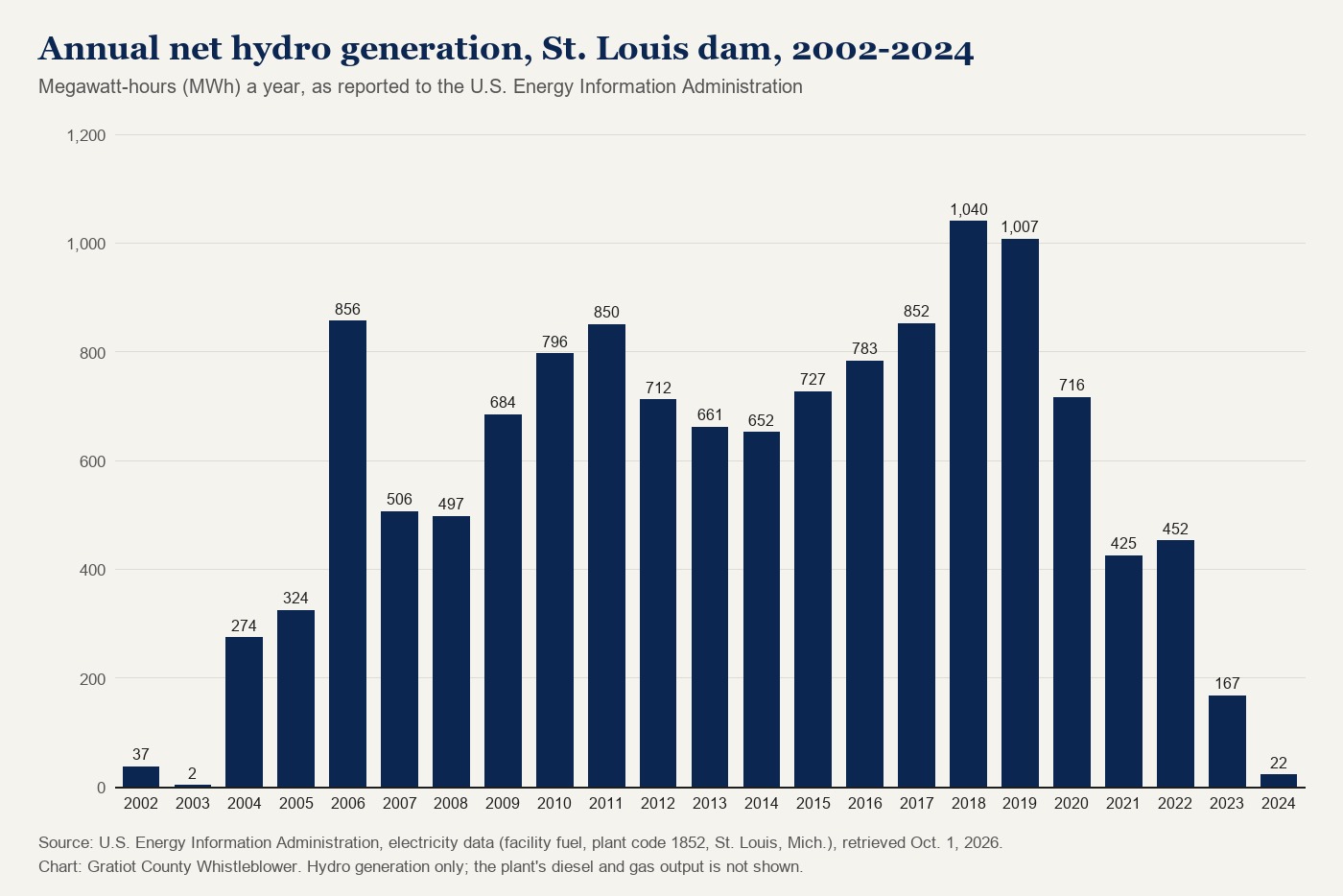
The U.S. Energy Information Administration (EIA) publishes annual net generation for the St. Louis plant (plant code 1852). Its hydro figures, in megawatt-hours (MWh), are shown in the chart above. By year: 2002, 37; 2003, 2; 2004, 274; 2005, 324; 2006, 856; 2007, 506; 2008, 497; 2009, 684; 2010, 796; 2011, 850; 2012, 712; 2013, 661; 2014, 652; 2015, 727; 2016, 783; 2017, 852; 2018, 1,040; 2019, 1,007; 2020, 716; 2021, 425; 2022, 452; 2023, 167; and 2024, 22. The highest year in the series is 2018. EIA’s monthly hydro series for the plant shows zero generation from May 2023 on, apart from 9 MWh in January 2024 and 13 MWh in February 2024.
The plant also has diesel and gas engines. Their output is not included here. EIA’s July 2026 generator inventory lists two hydro units, Nos. 5 and 6, at 0.2 megawatts each, both with the status “Operating.”
Sources: EIA electricity data, facility-fuel series for plant code 1852, annual net generation, hydro, 2002–2024, retrieved Oct. 1, 2026; EIA monthly series for the same plant, 2017–2024; EIA-860M generator inventory, July 2026.
FERC’s 2001 estimate
When it issued the license (97 FERC ¶ 62,184, Project No. 11428), the commission said the purpose of its economic analysis “is to provide a general estimate” of a project’s potential power benefits and costs. In that analysis FERC staff wrote that the Municipal Dam Project “would produce about 1,590,000 kWh annually.” That equals 1,590 MWh, the unit EIA uses. The order presents this as the commission staff’s estimate, made in 2001 dollars with the regional cost of alternative power, and not as a figure the city promised or guaranteed.
Source: FERC, Order Issuing Original License (Minor Project), City of St. Louis, Michigan, Project No. 11428, Nov. 29, 2001 (accession 20011129-3022), p. 8.
Current status, in the documents’ own words
NTH Consultants, the city’s engineering firm, wrote to the city’s director of public services on Oct. 27, 2025: “At this time the generators are not functioning and the dam is not generating electricity.” In a May 28, 2026 proposal to the city, NTH wrote: “Currently, the generators are not functioning, and the dam is not generating electricity.” Both letters were included in city council packets.
FERC’s Chicago Regional Office wrote to the city on Sept. 18, 2026, about the city’s 2025 Dam Safety Surveillance and Monitoring Report: “Also noted was that Hydro #6 is down for repairs due to a faulty exciter.” The letter asks the city to notify FERC “when this unit is back online, or if it will be down for an extended period of time.”
The two documents describe the plant differently: NTH refers to “the generators,” and FERC names one unit, Hydro #6. The documents do not say whether Hydro #5 is operating.
Sources: NTH Consultants proposal to the City of St. Louis, Oct. 27, 2025 (in the Nov. 4, 2025 council packet, p. 65); NTH proposal No. 25003130-20, May 28, 2026 (in the July 21, 2026 council packet, p. 127); FERC letter, Sept. 18, 2026, Project No. 11428 (accession 20260918-3076), p. 1.
What the records do not say
- Why output changed. None of the documents above gives a reason for the year-to-year changes in reported generation. The FERC letter gives a reason only for Hydro #6, a faulty exciter, and says nothing about earlier years.
- What a repair would cost. The documents give no repair estimate for either generator, and no date when the units are expected to return to service.
- Who paid for early construction. The records reviewed for this report do not state who paid to build the dam or the hydro units, or what those projects cost.
- How the estimate compares with actual operations. The FERC figure and the EIA figures were produced by different agencies for different purposes. This report does not compare them.
This is part one. A second report will follow. We are asking the City of St. Louis and other agencies for comment and records on the questions above, and we will keep seeking answers from the relevant departments. The City of St. Louis is welcome to respond at contactus@gcwhistleblower.com, and any response will be published in full.