
ITHACA — A Michigan law written in 1969 says a county that runs an animal shelter may sell unclaimed or unwanted dogs and cats to a Michigan research facility for no more than $10 apiece. That sentence is still on the books.
For years, Gratiot County was part of the system that law allowed. Two dogs reported to have passed through the county’s shelter, a Malamute named Koda and a Dalmatian mix named Queenie, ended up at two of the state’s largest universities. Each later gave a name to a bill in Lansing. Neither bill has become law.
This report sets out what the record shows, and says plainly where it stops.
Koda, 2007
Koda was a 3-year-old Malamute. CBS Detroit reported in June 2011 that his family surrendered him to the Gratiot County Animal Shelter on June 13, 2007. Six days later, the report said, he was sold to a federally licensed Class B dealer, a broker permitted to buy animals from shelters and other “random sources” and resell them for research. The dealer sold him to the University of Michigan.
He was used in the university’s trauma-training course and then euthanized, according to that report, which attributed the account to the Michigan director of the Humane Society of the United States. The university stopped using live animals in the course in February 2009, CBS Detroit reported.
The reports we reviewed do not name the dealer that bought Koda, and neither do we. We have not seen the county’s intake or transfer record for him.
The 2009 agreement
The Gratiot County Herald reported in January 2009 that members of several animal-welfare groups asked the Board of Commissioners not to renew the county’s five-year contract with R&R Research, a dealer based in Howard City, and that commissioners renewed it. The Herald’s report gives no vote count.
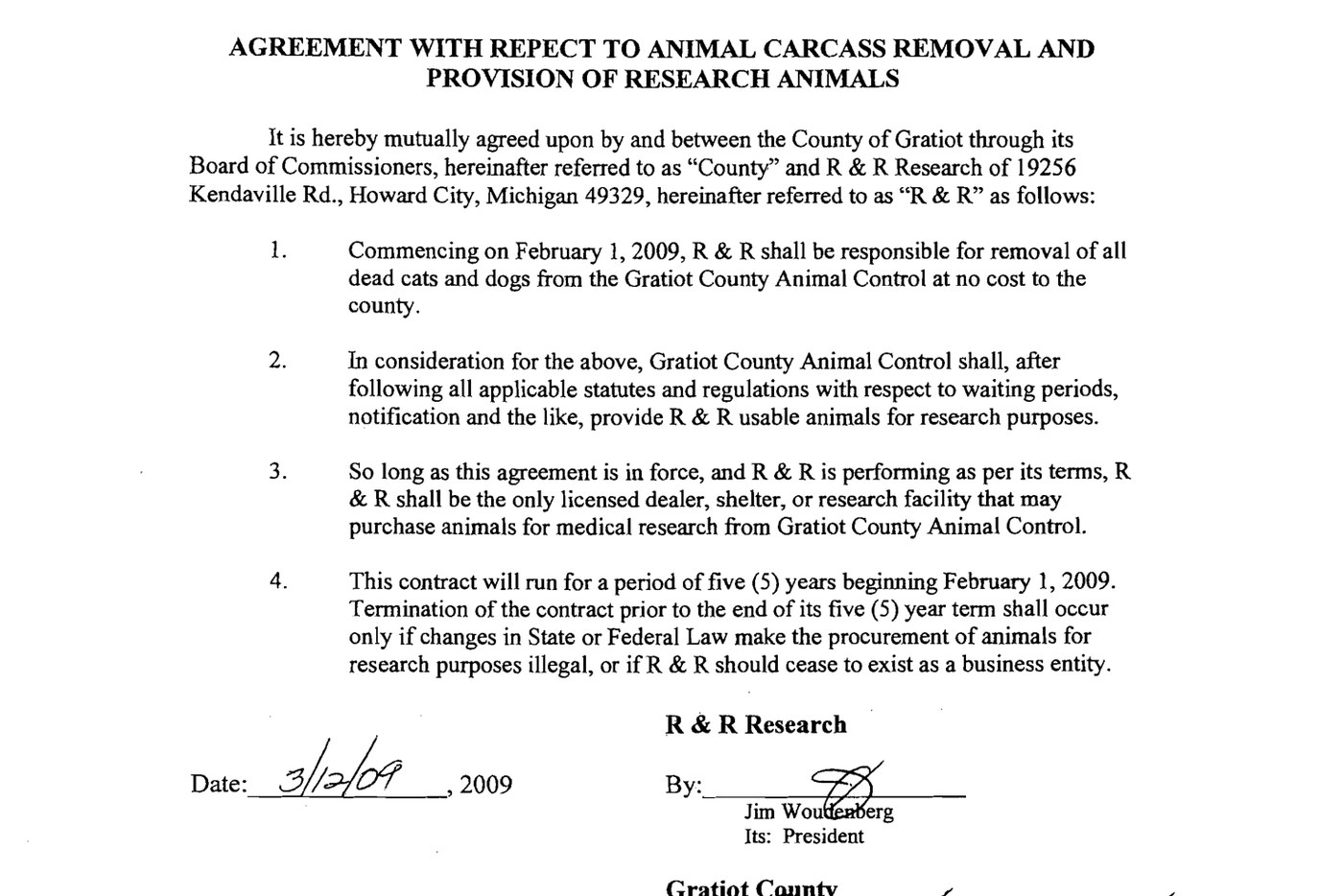
The agreement itself is a public record. It appears on page 82 of the county’s Jan. 8, 2013 board packet, where the county administrator presented it to newly seated commissioners. It is one page long and has four terms:
- From Feb. 1, 2009, R&R removes “all dead cats and dogs” from Animal Control “at no cost to the county.”
- “In consideration for the above,” Animal Control, after following the laws on waiting periods and notification, shall “provide R & R usable animals for research purposes.”
- While the agreement is in force, R&R “shall be the only licensed dealer, shelter, or research facility that may purchase animals for medical research from Gratiot County Animal Control.”
- It runs five years from Feb. 1, 2009, and can end early “only if” the law makes the practice illegal or R&R goes out of business.
The agreement states no price per animal and no number of animals. It is signed for R&R by its president and for the county by the board chairman, the administrator, the county attorney and the Animal Control director. The county signatures that carry dates are from March 2009.
How commissioners voted in 2009 is not known. The underlying board minutes have not yet been located. The county’s online meeting records begin in August 2010. We do not attribute a 2009 vote to any commissioner.
Queenie, 2009
Queenie was a female Dalmatian mix. A state senator’s office and Bridge Michigan have described her as a stray from Gratiot County. A 2019 report by the Physicians Committee for Responsible Medicine, which says it obtained Wayne State University’s purchasing and veterinary records for her under Michigan’s Freedom of Information Act, states that she arrived at Wayne State on Sept. 16, 2009, “from the Gratiot County Animal Shelter in Ithaca, Mich., by way of R&R Research.”
A county record touches this too, at one remove. On Feb. 21, 2012, a member of the public filed a handout with the board that included the group’s magazine cover story on Queenie. The cover reproduces what appears to be a Gratiot County Animal Control card, serial number 259, stamped “RELEASED TO R&R RESEARCH.” That is an advocacy publication reproduced in a county packet. The original card has not been located.
At Wayne State, Queenie was used in cardiovascular research. The Physicians Committee’s report quotes technicians’ notes describing whining, swelling at surgical sites and reluctance to stand, and says she was euthanized on June 29, 2010, after an implanted device broke.
What Wayne State says
Wayne State disputes the way Queenie’s case is presented. In a written response to questions raised at a Michigan House committee hearing, the university called the reference outdated, noting that she “underwent studies in 2010.” It said “a USDA review found interpretation of the medical record data was cherry-picked to portray a scenario far worse than what actually occurred,” and that the U.S. Department of Agriculture “performed a multi-day investigation regarding Queenie’s care; no animal care issues were identified.”
The university said its heart research has been funded by the National Institutes of Health since 1991, that using shelter animals was “a historical practice,” and that it has used only purpose-bred animals for the last decade. It wrote that using random-source animals “was outlawed by the USDA in 2015.” The federal document we located is narrower: a National Institutes of Health notice that barred NIH money for dogs from Class B dealers starting with fiscal 2015 awards.
This report does not settle the scientific dispute. It reports what the records say and what each side says about them.
2012: the board limits the arrangement
County minutes from 2012 show the issue returning to the board. On Jan. 17, the chairman said he had received more than 1,800 e-mails about R&R Research and the gassing of animals. On Feb. 7, the Animal Control director told commissioners the e-mails were “not a fair representation of your county residents.”
On March 20, 2012, the minutes record this action: “Motion by Bailey, second by Merignac to only give one animal a year to R&R Research until the contract expires.” The March 20, 2012 minutes record the motion as carried 6-0 with no votes against, but the clerk’s minutes contain an internal discrepancy over the individual vote list. For that reason we do not list who voted.
The motion was a limit, not a termination. A one-animal-a-year limit is not a term of the 2009 agreement, and no written amendment has been located. On May 1, 2012, a commissioner asked for discussion of a letter “from an attorney at Foster Swift regarding a breach of contract with R&R Research and the earlier resolution passed.” The board then met in closed session on June 5 and June 12 to discuss attorney-client correspondence about R&R. On Aug. 14, the chairman said: “The Resolution still stands, but the Board did send questions to counsel.” The letter, any county reply and the outcome are not in the online record.
The numbers
A table handed to the board on Feb. 12, 2013, compiled by the rescue group Help Furry Friends, lists animals that left the county shelter “to research”: 376 in 2006, 287 in 2007, 346 in 2008, 171 in 2009, 30 in 2010 and 39 in 2011. The county’s own annual reports behind those figures have not been obtained. The Animal Control quarterly reports we did find show zero dogs and zero cats sent to research in April through June 2012 and in October through December 2012.
The written 2009 agreement’s stated five-year term would have ended January 31, 2014. No subsequent renewal has yet been located. The county’s shelter operating procedures, effective March 5, 2019, state: “Gratiot County does not sell, nor otherwise supply, live animals for research to any organization.”
The bills
Koda’s Law. House Bill 4663 of 2009 would have let a person surrendering a pet say whether it could go to research, barred shelters from giving strays to dealers, and deleted the $10 provision. The House passed it 78 to 20 on July 28, 2010. It died in a Senate committee.
Queenie’s Law. House Bill 4254 of 2025 would bar a public body, including a public university, from using a dog in an experiment that causes pain or distress. On Oct. 30, 2025, the House Regulatory Reform Committee voted 14-0, with two members passing, to send it to the Rules Committee, according to the committee’s minutes. The full House has not voted. The Senate version, Senate Bill 127, was referred to the Regulatory Affairs Committee on March 6, 2025, and that is the last formal action on it. The committee took testimony on May 20, 2026, without a vote. Both statuses were checked on Sept. 30, 2026.
Neither bill would change the 1969 statute on shelter animals.
What we could not establish
- How any commissioner voted on the 2009 agreement, the tally, or the meeting date.
- Which dealer bought Koda.
- The county’s own intake and transfer records for either dog.
- What R&R’s lawyers claimed in 2012, what the county answered, and how the dispute ended.
- When the last animal went from the county shelter to research.
- What happened when the agreement’s term ran out.
These gaps need records requests, which under Michigan law must carry a requester’s name and address. They are among the first tasks for the volunteer public representatives this publication is recruiting. Gratiot County, Wayne State University, the University of Michigan and R&R Research have not been asked to comment for this report. Each is welcome to respond at contactus@gcwhistleblower.com, and any response will be published.