
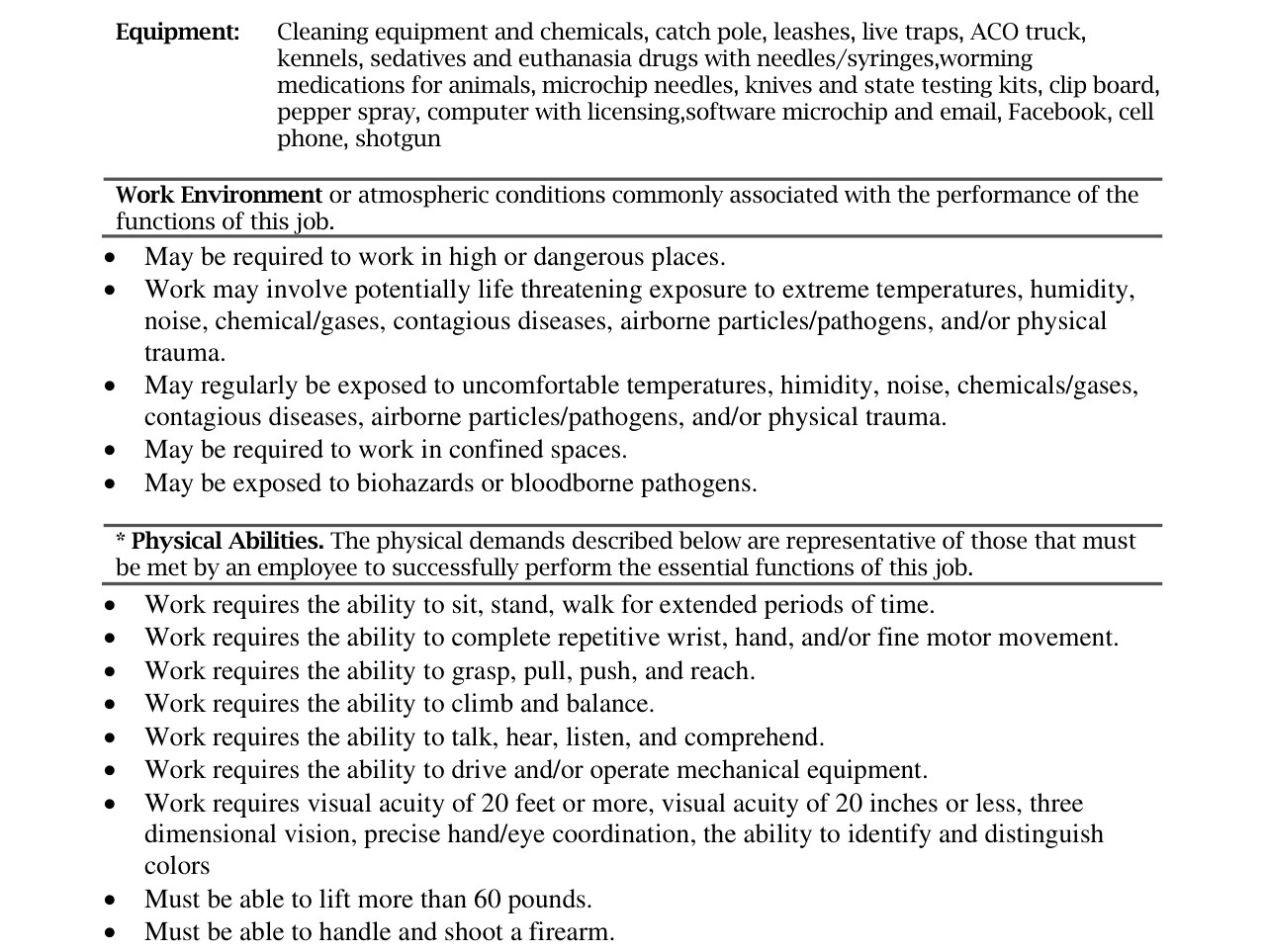
GRATIOT COUNTY — Gratiot County’s own job description for Animal Control Officer lists a shotgun as equipment, requires firearm training and says an officer “must be able to handle and shoot a firearm,” for work it warns “may involve potentially life threatening exposure.” On Oct. 20 the Board of Commissioners voted 5–0, on an item added to the agenda from the floor, to end officers’ authorization to carry or have access to firearms on duty. The county administrator said the sheriff had asked the board to wait. The board did not. No one speaking for the department is heard on the recording, and the county’s posted job description has not been changed.
The record at a glance
- The county’s document: a shotgun is listed under equipment, firearm training is a minimum qualification and shooting a firearm is a physical requirement.
- The department’s case in 2025: when it asked the board to let officers carry sidearms, the director called firearms “a necessary tool for immediate protection.”
- The vote: 5–0 on Oct. 20, on an item the posted agenda did not list, about 17 minutes after it was introduced.
- The reason given: an insurance endorsement of about $95,000 a year, plus about $8,000 a year in workers’ compensation, in the administrator’s account.
- Not on the recording: any discussion of officer safety, of the hazards the job description lists, or of what officers will use instead.
What the county’s own document says
The job description is a four-page PDF on the county website, with a header reading “Effective Date: 6/1/24” and no revision date. Three things in it concern firearms:
- Minimum qualifications (page 1): “Completion of Firearm Safefty training with the ability to legally carry a firearm in the state of Michigan.” The spelling is the county’s.
- Equipment (page 3): a catch pole, live traps, sedatives and euthanasia drugs, knives, state testing kits, pepper spray and, last on the list, a “shotgun.”
- Physical abilities (page 3): “Must be able to handle and shoot a firearm.”
On the same page, under work environment, the document says an officer “may be required to work in high or dangerous places” and that “work may involve potentially life threatening exposure to extreme temperatures, humidity, noise, chemical/gases, contagious diseases, airborne particles/pathogens, and/or physical trauma.” It adds that officers may be required to work in confined spaces and may be exposed to biohazards or bloodborne pathogens. The document does not say why a firearm is listed. It lists it as equipment, beside pepper spray and a catch pole, for a job it describes as potentially life threatening.
The document classifies the job as Grade 2 and names the Animal Control Administrator as the position’s supervisor. Its duties include “Collaborate with law enforcement and other agencies to address animal-related concerns”; responding to law enforcement calls is not among them.
What the department told the board in 2025
On March 18, 2025 the same five commissioners voted unanimously to place Animal Control under the sheriff’s office, as described in our Oct. 21 report. On the county’s recording of that meeting, the animal control director presented the request as a safety measure. Per the recording’s automatic captions, the director said “sidearms can be an essential tool in some of these scenarios, ensuring that officers make it home safely to their families” (54:48) and that firearms provide “a necessary tool for immediate protection” when non-lethal methods such as a catch pole are unavailable or ineffective (55:42), and that officers often work alone (59:39). Sheriff Tom Clark told the board he was seeking to give officers the tools “to make them as safe as possible” (1:12:31). Asked whether officers would keep shotguns in their vehicles, the captions record the answer “absolutely yes” (1:24:55). The captions are automatic, so exact wording may differ slightly.
How the Oct. 20 vote happened
The posted agenda listed one new-business item, a Conservation District agreement; Animal Control was not on it. In the first minute the chair raised one addition, a “resolution for animal control” (0:59), and the board approved the agenda as amended. Public comment on agenda items followed moments later (1:58). The item itself was introduced at about 44 minutes (44:18).
County Administrator Timothy Dolehanty said he and the deputy administrator had met Oct. 12 with the county’s liability carrier, the Michigan Municipal Risk Management Authority, about officers having “a sidearm” and a second firearm in the vehicle (45:09). He said Sheriff Clark and the animal control director attended that meeting (45:29), that officers are not certified through the state’s law enforcement standards commission and that officers under the sheriff were also allowed to self-dispatch to law enforcement calls (47:24). He said the insurer added an endorsement costing an additional $95,000 a year (48:55) and that, with about $8,000 a year in workers’ compensation, the county was paying “about another 100,000 a year” (53:10).
He offered two resolutions: keep Animal Control under the sheriff and direct the sheriff to end firearms access, or move it to the administrator’s office and direct the administrator to do so. He said the sheriff, as an elected official, was under no obligation to follow a board direction, and of the second option said, “you direct me to do that, either I do it or I’m history” (55:09).
He then told the board the sheriff was at a conference in Traverse City (56:30) and “did ask that you table the matter until he can attend next month’s meeting” (56:44), adding that waiting would mean expenses “in excess of $5,000” (56:52). A commissioner asked where the $5,000 would come from (58:19). Commissioner Jan Bunting moved the second resolution, Commissioner George Bailey supported it, and it passed on a roll call of Bailey, Bunting, Tim Gay, Steve Sopocy and Chair Dave Owens, all yes (1:01:04). The administrator said the order would go out “first thing in the morning.”
Who was not heard
The sheriff, who supervised the officers, was away and asked the board to wait, in the administrator’s account. The recording contains no statement on the resolution from the sheriff or from the animal control director. This publication understands the director was not at the meeting; the approved minutes will list attendance. The administrator said both had attended the insurer meeting eight days earlier, so the record does not show that they were unaware of the review. It does not show whether either was told the board would act Oct. 20, or when the resolution was written: it was not posted with the agenda.
In the roughly 17 minutes between the item’s introduction and the vote, the recording has no discussion of officer safety, of the hazards the job description lists, of the 2025 safety case or of what officers will carry for protection. The one reference to what comes next is a commissioner’s question, “We will write a new policy for them also, right?” (1:00:42), answered “Yeah, and I’ll support that.” The record does not show that a policy has been written or posted.
The same night: $95,000 and $90,000
About 18 minutes before that vote, the board approved funding for the Gratiot Conservation District at up to $90,000 on a 3–2 vote (42:54), after a motion for the district’s full $134,187.04 request failed 2–3. The district’s staff are district employees, not county employees, and the agreement runs from about Oct. 21, 2026 through Sept. 30, 2027, as described in our report on that vote.
Moments after the roll call on Animal Control, a voice at the table said, “Now that 95,000 we saved can go to Kevin’s (1:01:15).” The county’s captions mark laughter. Kevin Craig is the chair of the Conservation District’s board and had presented the district’s request earlier in the meeting. The speaker is not identified on the recording. The two amounts come from different budgets for different purposes: an insurance endorsement, and a not-to-exceed services agreement with a separate district. The record shows no transfer between them, and no posted document says which fund pays for either.
Is there a new job description?
As of Oct. 23 the county’s posted description has not changed. It carries the 6/1/24 effective date and no revision date; the file’s own metadata shows it was created Dec. 11, 2024. We requested it from several browsers and with cache-busting parameters, and every request returned the identical file. We have seen no revised, draft or interim description. A revised version could exist internally without being posted; the public record does not show one. We are asking the county for any revised or draft job description for Animal Control Officer, its revision history and the date of any change.
What the record does not show
The record does not show the written text of the resolution or its final number: the county’s Oct. 6 minutes use 26-468 for a different item, and the recording shows two animal control alternatives sharing that number. It does not show whether the insurer has reduced or removed the endorsement, whether the firearms and shotguns have been collected, what officers have been told to use, or whether any officer was consulted. It establishes no motive beyond the reasons stated on the recording.
Questions that remain
- What is the written policy that replaces firearms access, and when does it take effect?
- Did the board see any assessment of officer safety, call history or alternatives before voting?
- Was the sheriff told in advance that the board would act Oct. 20, and was the animal control director told?
- Has the insurer confirmed in writing that the $95,000 endorsement has been reduced or removed?
- Will the county revise the job description, and will firearm training remain a condition of hire?
Corrections and responses are welcome.